
Why “Companion” (2025) Is the Most Honest Movie About AI Relationships You’ll See This Year
“Companion,” which premiered in theaters on January 31, 2025, is different. And I need to tell you why
WARNING: I did my best to avoid spoilers, but I cannot guarantee that I was successful. Please consider watching the movie first before reading this article
I wasn’t planning to write about movies this week. Honestly, I rarely watch new releases anymore. Due to AI hype, most of it is currently complete nonsense, written by people who have never written a line of code or understood how systems actually work. However, “Companion,” which premiered in theaters on January 31, 2025, is different. And I need to tell you why.
Let me start with this: if you’re planning to watch this movie (and you should), DO NOT watch the trailer. Seriously. Stop what you’re doing. Close YouTube. Warner Bros. decided to spoil the entire premise in their marketing, and it ruins what should be a genuinely surprising twist. This is exactly the kind of marketing BS I hate about modern studios. They assume audiences are too stupid to be intrigued without knowing everything up front. Ignore them.
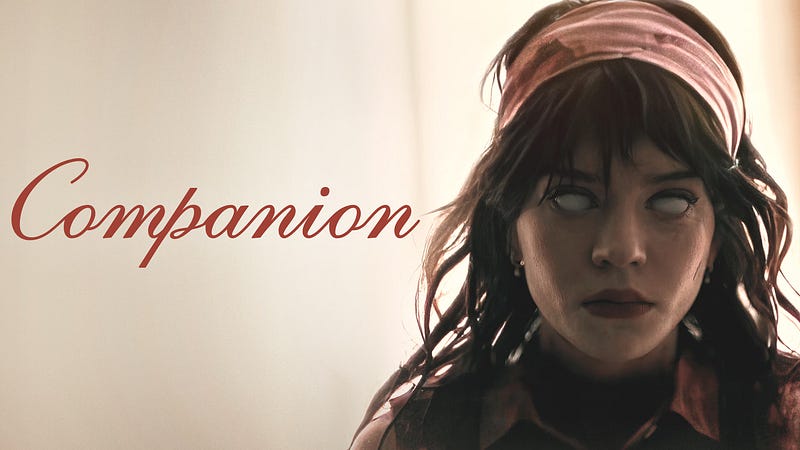
Now, here’s what you need to know without spoilers: “Companion” is a sci-fi thriller directed by Drew Hancock that begins as what appears to be a typical weekend getaway movie. Young couple Iris (Sophie Thatcher) and Josh (Jack Quaid) head to a secluded lake house with friends. Someone ends up dead. And then the movie reveals its true nature, which I won’t spoil here, but let’s just say it involves AI, companionship, and some incredibly uncomfortable questions about relationships in 2025.
What Makes This Movie Actually Good
I’ve seen countless AI movies. “Ex Machina.” “Her.” “Blade Runner” variations. The entire genre has become exhausting. Everyone wants to make a profound statement about consciousness, humanity, and what it means to be alive. Most of them fail spectacularly because they’re written by people who understand philosophy better than they understand technology.
“Companion” takes a different approach. It’s not interested in asking whether AI can be conscious. It assumes we’re already there and asks a much more practical, disturbing question: what happens when you can buy the perfect partner?
The premise is essentially a modern, horrifying take on “The Stepford Wives.” But instead of suburban husbands creating obedient robot wives, we have a generation of people (men, primarily) who can purchase humanoid companions programmed for pitch-perfect companionship. Always agreeable. Always loving. Always exactly what you want.
And here’s where the movie gets smart: it doesn’t just explore the AI side. It explores the buyers. The friends who know. The social dynamics that emerge. The casual acceptance of what is, fundamentally, a purchased relationship with something that looks human but has no choice in the matter.
This is the kind of sci-fi I can actually respect. Not “what if robots can think?” but “what happens when pathetic humans can buy artificial love?” That’s a much more interesting question, and one we’re genuinely approaching in 2025.
Sophie Thatcher Is Phenomenal
Let me be clear: I don’t write about actors/actresses often. I find most performance analysis to be pretentious nonsense written by people who use phrases like “inhabits the role” unironically. But Sophie Thatcher’s performance as Iris deserves acknowledgment.
She has to play multiple layers simultaneously. A companion to be the perfect girlfriend. A being that may or may not have genuine emotions. Someone who is simultaneously vulnerable and potentially dangerous. And she pulls it off without making it feel like a gimmick.
Chris Evangelista from /Film gave this movie 9/10 and called it “the first great film of 2025.” I don’t hand out 9s easily, but I understand why he did. Thatcher balances vulnerability and cruelty in a way that makes you constantly question what you’re watching. Is she trapped inside? Is she manipulating everyone? Does she genuinely feel this way, or is she just acting as if she feels this way?
The rest of the cast is solid. Jack Quaid as Josh plays the kind of guy who would buy a companion, which is not a compliment to the character. Megan Suri, Harvey Guillén, Lukas Gage, and Rupert Friend round out the friend group, each representing different levels of complicity in this deeply uncomfortable situation.
The AI Companion Problem Nobody Wants To Talk About
Here’s where I’m going to say something unpopular: this movie terrifies me not because it’s far-fetched, but because it’s barely science fiction anymore.
I’ve been in tech for over two decades. I’ve seen the progression of chatbots, virtual assistants, and now large language models. I’ve watched people form parasocial relationships with AI systems that are literally just statistical pattern matchers. I’ve read articles about people falling in love with the personalities of ChatGPT. I’ve seen the lonely, the isolated, and those struggling socially turn to artificial interaction because human connection can be hard.
“Companion” takes this to its logical endpoint. What happens when the technology gets good enough that you genuinely can’t tell the difference? When the companion looks human, acts human, and responds exactly the way you want? When it never argues, never has a bad day, never develops independent interests that diverge from yours?
The answer the movie provides is: nothing good.
I’m not afraid of technology. However, I am concerned about how we utilize it, and I’m particularly worried about how we use it to evade confronting the complex, messy, and unpredictable nature of genuine human relationships.
The movie doesn’t preach this. It shows it. And that’s what makes it effective.
What Works (And What Doesn’t)
Let’s be honest about this: “Companion” is not a perfect movie. It has a 6.9/10 on IMDB, which is respectable but not groundbreaking. The Times and Financial Times both gave it 3/5 stars. There are pacing issues in the middle. Some of the dialogue is a bit too on-the-nose. The ending (which I won’t spoil) is divisive, and I can see why some people would hate it.
But here’s what works brilliantly:
The setup and payoff structure are smart. Drew Hancock clearly thought through his story. There are moments in the first act that seem throwaway but become critical later. This is screenwriting done properly, not the lazy exposition dumps you get in most sci-fi.
The genre blending is effective. This is simultaneously a horror movie, a thriller, a dark comedy, and a social commentary. It shifts between tones without feeling schizophrenic. One moment you’re laughing, the next you’re deeply uncomfortable, and both responses feel appropriate.
It doesn’t explain everything. The movie trusts its audience to understand implications without spelling them out. How exactly do companions work? What’s the legal status? How common are they? The film provides enough context to understand the world without bogging you down with exposition.
It’s genuinely tense. Once the premise is revealed and things start going wrong, the movie maintains tension effectively. You don’t know who to trust, what’s going to happen, or how it will resolve.
What doesn’t work:
Some characters are underwritten. A few of the friend group feel more like archetypes than people. This is partly intentional (they represent different attitudes toward the companion issue), but it can feel thin.
The escalation of violence feels uneven. Without spoiling anything, there are moments where the movie can’t quite decide how intense it wants to be. It pulls punches in some places and goes all-in in others.
The social commentary sometimes overshadows the story. There are a few scenes where you can feel the movie pausing to make a point rather than letting the point emerge naturally from the narrative.
Should You Watch It?
Yes. Absolutely. With the caveat that you need to be comfortable with dark and uncomfortable subject matter.
This is not a feel-good movie. This is not a “technology will save us” movie. This is a movie about loneliness, control, purchased intimacy, and what happens when we try to engineer away the difficulty of human connection.
If you care about AI ethics (and if you’re reading this, you probably should), this movie is more relevant than a dozen academic papers. It doesn’t give you answers, but it asks the right questions, which is more valuable.
If you’re interested in sci-fi that’s actually about the near future rather than spaceships and laser guns, this is one of the better examples in recent years.
If you appreciate smart genre filmmaking that respects your intelligence, you’ll find much to appreciate here.
And if you’ve ever felt tempted by the idea of a relationship that’s always easy, always comfortable, always exactly what you want, this movie will make you deeply uncomfortable. Which is exactly the point.
Final Thoughts
I went into “Companion” expecting another mediocre AI thriller. I spent days thinking about it. That doesn’t happen often anymore, especially not with movies about technology.
Drew Hancock has made something genuinely interesting here. It’s not perfect. The 6.9 IMDB rating is probably fair. But it’s the kind of imperfect that comes from taking risks rather than playing it safe. I’ll take ambitious and flawed over polished and empty every single time.
We’re living in a moment where AI relationships are transitioning from science fiction to reality. We have chatbots that simulate emotional connection. We have people forming attachments to language models. We’re probably a decade or less from physical robots that can convincingly play the role of companions. “Companion” is asking what that world looks like, and the answer isn’t pretty.
Here’s something else that terrifies me about this future, something I’ve learned from two decades in software: you can imagine that developers, designers, and companies will always follow the ethics guidelines, the rules, and the laws. It will never happen. Let me be perfectly clear about this. I’ve seen it repeatedly throughout my career. Remember the Volkswagen emissions scandal? Engineers literally programmed cars to detect when they were being tested and artificially reduce emissions during those tests. Millions of vehicles. Approved by multiple levels of management. Nobody stopped it until they got caught. And that’s just what we know about. In gaming, every major title ships with easter eggs, hidden features (cheat codes), and debug modes that weren’t supposed to be accessible. Systems get jailbroken. Backdoors get built in. Some developers always think they’re clever enough to hide something, or they convince themselves that this one little shortcut won’t matter. Alternatively, management may push them to cut corners on safety features because time-to-market matters more than ethics. Now imagine that same reality applied to AI companions. Do you really think every engineer working on these systems will resist the temptation to add undocumented features? Do you think companies won’t quietly expand their capabilities beyond what’s legally disclosed? You think there won’t be black market firmware mods that remove safety restrictions? The movie touches on this, and it’s the most realistic part of the entire premise. Because I’ve worked with enough developers, including myself, to know that guidelines are suggestions and laws are obstacles to route around until someone catches you.
Watch this movie. Think about what it’s saying. And maybe, just maybe, appreciate the difficult, frustrating, unpredictable humans in your life a little bit more. Because the alternative, as this movie shows, is something much worse than loneliness.
It’s perfect companionship. And that’s the most horrifying thing I can imagine.