
NVIDIA Pascal Dropped: Arch Linux Systems Without Graphical Fallback
NVIDIA dropped Pascal GPU support. Arch Linux users updated and lost graphical environments. Proprietary drivers strike again with no…

NVIDIA dropped Pascal GPU support. Arch Linux users updated and lost graphical environments. Proprietary drivers strike again with no fallback path.
No warning. No graphical fallback. Arch Linux users with GTX 10xx series cards updated their systems during the holiday week. When they rebooted, they stared at a command line. Their desktop environments vanished.
This is what happens when proprietary driver dependencies meet rolling release distributions. And the handling of this transition exposes everything wrong with closed-source GPU support on Linux.
If you’ve ever felt frustrated by proprietary drivers on Linux, clap so others can find this analysis.
The Pascal Support Drop
NVIDIA announced they would end support for Pascal and Maxwell GPU architectures in their proprietary drivers. The GTX 10xx series (Pascal), released in 2016, represents millions of cards still in active use.
The transition timeline was clear to those paying attention. But “clear” and “communicated effectively to end users” are different things entirely.

Pascal GPUs served the gaming and professional Linux community for eight years. That is a reasonable support window by hardware standards. The problem is not that NVIDIA dropped support. The problem is how the ecosystem handled the transition.
I am a human writer who gets motivated to write more with your support! You don’t need to pay. I just need your clap 👏 if you like my story and comment ✍️ if you want to say something. You can follow me on Medium, LinkedIn, Instagram and X.
What Happened on Arch Linux
Arch Linux is a rolling release distribution. Users run pacman -Syu to update everything at once. There is no concept of "stable releases" with carefully tested package combinations.
When the new NVIDIA driver packages arrived in Arch repositories, they replaced the Pascal-compatible versions. Users with GTX 10xx or Maxwell cards updated, rebooted, and found themselves without a working graphical environment.
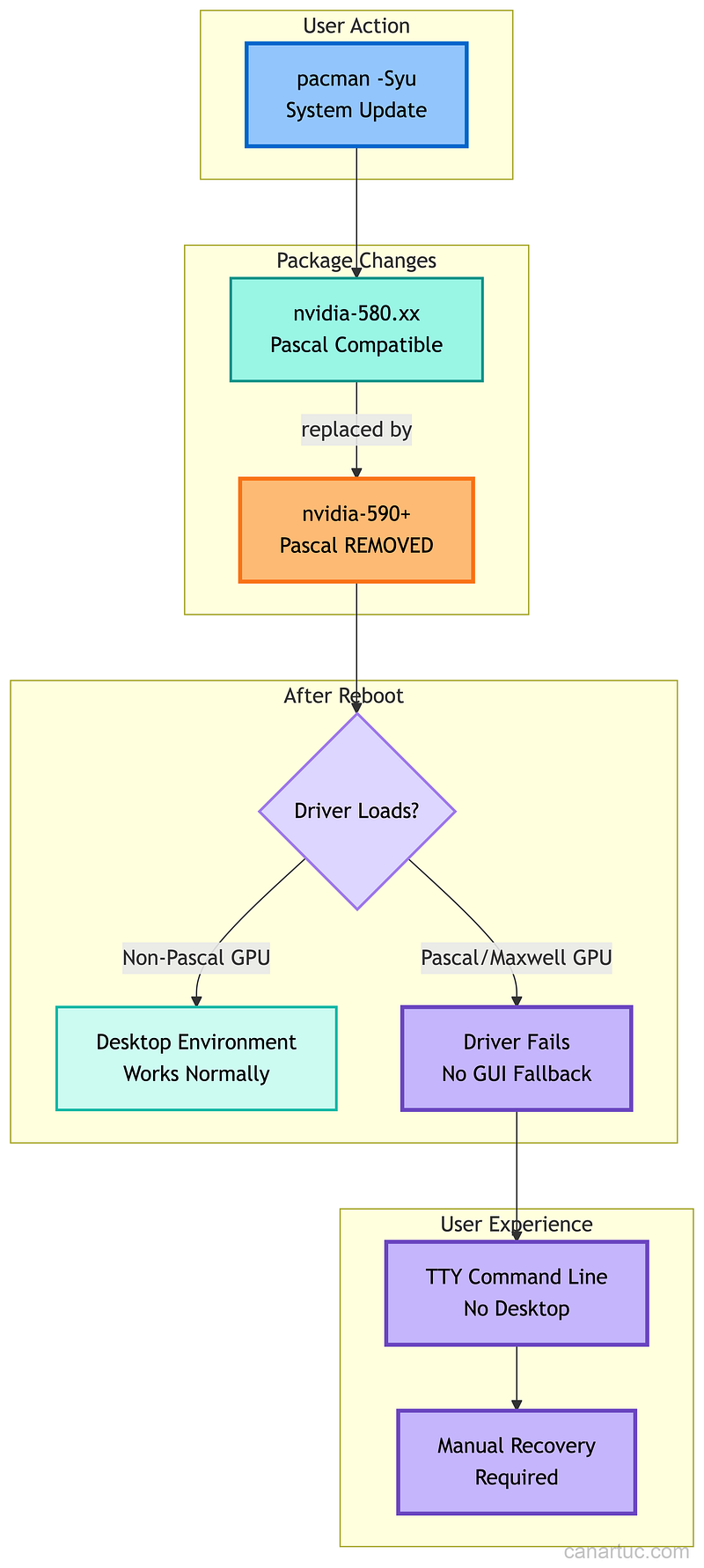
No warning message during update. No automatic fallback to nouveau (the open-source NVIDIA driver). No detection of hardware that would break. Just a silent update that bricked graphical sessions.
The handling has been described as “terrible” by affected users. And honestly, that assessment is generous.
The Proprietary Driver Problem
After 20+ years in tech, I have watched this pattern repeat across multiple hardware generations. Proprietary drivers create invisible dependencies that only surface during transitions.
Here is the fundamental issue with closed-source GPU drivers:
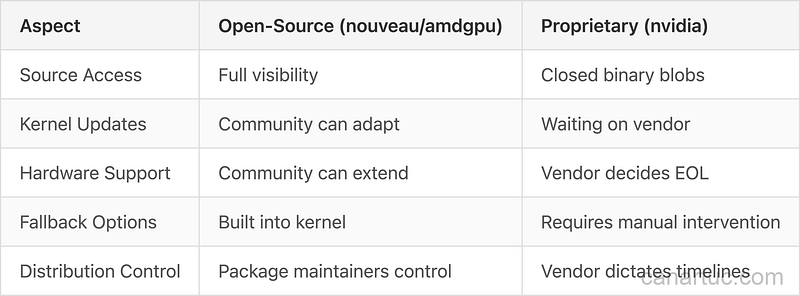
The nouveau driver exists for NVIDIA hardware. It provides basic functionality. But NVIDIA has historically limited access to firmware and documentation that would enable full performance. This is not a technical limitation. It is a business decision.
Have you experienced proprietary driver failures on Linux? Tell me in the comments how you handled the recovery.
What Should Have Happened
A proper transition for deprecated hardware support would include several elements that were missing here.
Pre-update detection: The package manager should check installed hardware against driver compatibility before allowing updates. This is technically feasible. Many distributions already do hardware detection.
Graceful fallback: If the new driver fails to initialize, the system should automatically fall back to nouveau or a framebuffer console with clear instructions. Not just dump users at a TTY with no context.
Version pinning guidance: Users with legacy hardware should receive explicit instructions on how to pin to the last compatible driver version before the update lands.
Transition packages: Legacy driver packages (nvidia-580xx for Pascal/Maxwell, nvidia-470xx for Kepler, nvidia-390xx for older) exist for different hardware generations. The ecosystem should guide users toward the appropriate legacy driver before removing support.
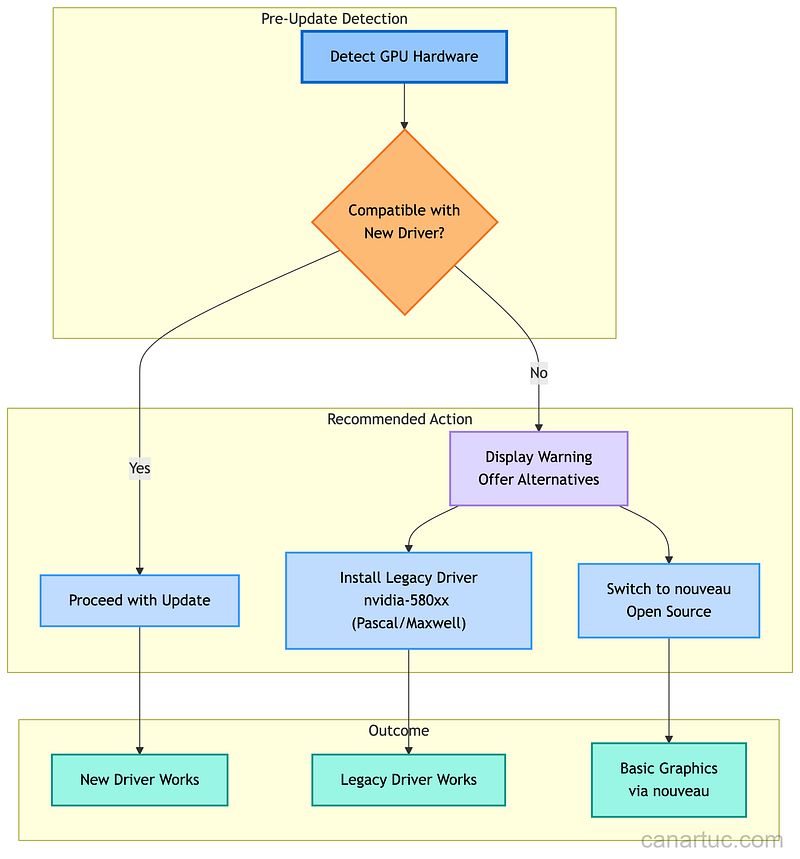
None of this happened. Users updated and got broken systems during the holiday period when many maintainers are unavailable.
The Arch Linux Factor
Critics will say “this is Arch, users should expect this.” I have heard that argument for decades. It misses the point.
Arch Linux users accept responsibility for maintaining their systems. They read the news, follow mailing lists, and understand that rolling releases carry risk. But that implicit contract assumes the ecosystem provides clear information.
The transition happened without prominent warnings. The Arch Wiki, usually comprehensive, had incomplete guidance. The package update did not flag the breaking change.
Rolling releases work when the community infrastructure supports informed decisions. That infrastructure failed here.
Recovery Path for Affected Users
If you are staring at a command line on your Pascal or Maxwell system, here is the path forward:
Step 1: Boot from a live USB or switch to a TTY (Ctrl+Alt+F2).
Step 2: Uninstall the incompatible driver:
pacman -Rdd nvidia nvidia-utilsStep 3: Install the legacy driver from AUR:
# Use an AUR helper like yay or paru
yay -S nvidia-580xx-dkms nvidia-580xx-utils
Step 4: Alternatively, switch to nouveau:
pacman -S xf86-video-nouveauStep 5: Rebuild initramfs:
mkinitcpio -PStep 6: Reboot and hope.
The “hope” part should not be necessary. But here we are.
Lessons for the Linux Desktop
This incident reinforces several realities about the Linux desktop ecosystem in 2025.
AMD’s open-source approach matters: AMD’s amdgpu driver is mainline kernel. When hardware reaches end-of-life, the community can maintain it indefinitely. NVIDIA’s closed model means support ends when NVIDIA decides.
Rolling releases need better tooling: Distribution-agnostic hardware compatibility databases should warn users before breaking updates. This is a solvable problem.
Proprietary dependencies are technical debt: Every system running proprietary NVIDIA drivers carries invisible risk. When the vendor changes direction, users pay the price.
Communication remains the weakest link: Technical solutions exist. The challenge is consistently communicating breaking changes to affected users before they run updates.
The Real Cost
I architected 14 platforms across telecommunications, digital health, media, and conversational AI. Every one of those projects included risk assessments for vendor dependency. Hardware drivers rarely made the list because they seemed stable.
This incident reminds us that vendor dependency extends to every layer of the stack. A GPU driver is as critical as any API dependency. The transition costs, support burdens, and user frustration are real.
NVIDIA makes excellent hardware. Their Linux support has improved dramatically over the years. But their proprietary approach creates brittleness that open-source alternatives avoid by design.
The GTX 10xx series will continue working. Users will find workarounds. But each of these incidents erodes trust and strengthens the case for open-source alternatives.
Start your migration planning if you run NVIDIA hardware on rolling releases. Legacy driver packages work today. They will not be maintained forever.
What is your experience with NVIDIA driver transitions on Linux? Have you switched to AMD or stayed with NVIDIA despite these challenges?
I am a human writer who gets motivated to write more with your support! You don’t need to pay. I just need your clap 👏 if you like my story and comment ✍️ if you want to say something. You can follow me on Medium, LinkedIn, Instagram and X.