
NixOS vs Fedora Silverblue: Immutable Linux Distributions Compared
NixOS declarative config vs Fedora Silverblue atomic updates. Here’s why immutable Linux isn’t for everyone yet.
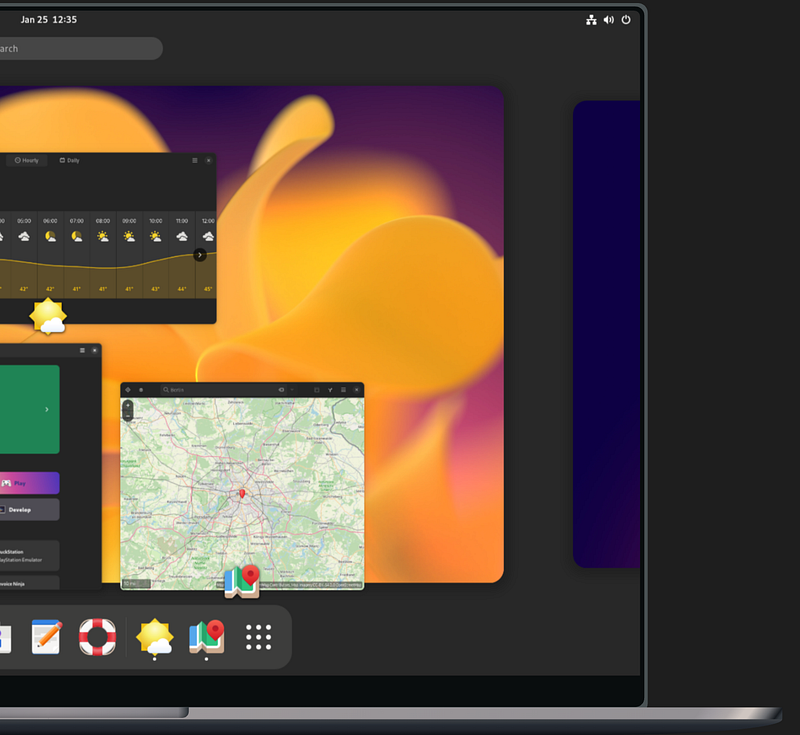
Three architectures. Three philosophies. One promise: never break your system again. Immutable Linux distributions claim to solve dependency hell, configuration drift, and upgrade anxiety.After 20+ years in tech, I’ve seen every flavor of “this will fix everything.” Immutable distros are genuinely different. But they come with trade-offs most advocates conveniently forget to mention.
The Immutable Promise
The pitch is compelling. Your root filesystem becomes read-only. Updates happen atomically (they either complete fully or roll back entirely). You can reproduce your exact system configuration on any machine.
No more “it works on my machine.” No more broken upgrades leaving you in dependency limbo.
I switched from macOS to Linux after 20 years. The timing coincided with my exploration of immutable distributions. What I found was a genuine paradigm shift wrapped in a steep learning curve.
The reality is more nuanced than the marketing.
Immutable distributions solve real problems. But “immutable” is an umbrella term covering fundamentally different architectures. NixOS, Fedora Silverblue, and VanillaOS each take radically different approaches. Choosing the wrong one for your use case creates more friction than traditional distributions ever did.
Three Architectures Compared
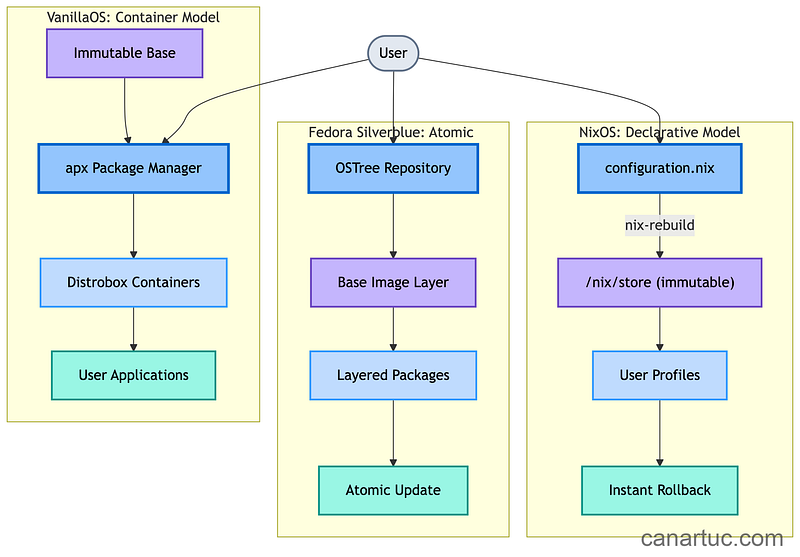
Let me break down what actually differs between these systems.
I am a human writer who gets motivated to write more with your support! You don’t need to pay. I just need your clap 👏 if you like my story and comment ✍️ if you want to say something. You can follow me on Medium, LinkedIn, Instagram, and X.
NixOS: The Declarative Purist
NixOS takes the most radical approach. Your entire system is defined in a single configuration file (or set of files). Every package, service, and configuration option lives in configuration.nix.
Want to install Firefox, enable SSH, and configure your timezone? You declare it:
environment.systemPackages = [ pkgs.firefox ];
services.sshd.enable = true;
time.timeZone = "Europe/Berlin";
Then run nixos-rebuild switch. The Nix package manager calculates dependencies, builds everything in isolation, and atomically switches your system to the new configuration.
The power is reproducibility. Share that configuration file, and anyone can recreate your exact system. The ability to version control your entire operating system configuration? That’s genuinely transformative for compliance and disaster recovery.
The cost is the learning curve. Nix has its own functional language. The documentation assumes familiarity with concepts most Linux users have never encountered. I can tell you: adoption friction kills even the best tools.
If this resonates with your infrastructure challenges, clap so other architects can find it.
Fedora Silverblue: The Pragmatic Middle Ground
Silverblue uses OSTree to manage system images. Think of it like Git for your operating system. The base system is an immutable image. Updates download a new image and switch atomically on reboot.
You can still install packages, but they’re “layered” on top of the base image using rpm-ostree. Need a development tool that isn't in Flatpak?
rpm-ostree install vim-enhancedReboot, and it’s available. The original image remains intact underneath.
Silverblue’s strength is familiarity. If you know Fedora, you’re 80% there. The tooling builds on concepts you already understand. Flatpak handles most desktop applications. Toolbx provides containerized development environments.
The limitation is layering overhead. Every layered package extends your update time. Layer too many packages, and you lose the benefits of atomic updates. I’ve seen teams layer 50+ packages and wonder why their “atomic” system takes 20 minutes to update.
VanillaOS: The Container Philosophy
VanillaOS takes immutability a step further. The base system is completely immutable. All software installation happens through containers using apx, which creates Distrobox environments under the hood.
Want to install something from Ubuntu’s repositories? Create an Ubuntu container. Need Arch packages? Create an Arch container. Each environment is isolated, and applications integrate seamlessly with your desktop.
This is the cleanest separation of concerns. Your base system never changes. Applications live in disposable containers. Broke something? Delete the container and start fresh.
The trade-off is complexity for power users. System-level modifications require jumping through hoops. If you need kernel modules or deep system integration, VanillaOS will fight you at every step.
Living with Immutability Daily
I’ve run NixOS on development machines and Silverblue on daily drivers. Here’s what the documentation doesn’t tell you.
Software Installation Reality
On traditional Linux, apt install or dnf install gets you almost anything. On immutable distributions, your options fragment:
Flatpak (all three): Good for desktop apps, limited for CLI tools
Native packages (layered on Silverblue, declared on NixOS): Full capability, management overhead
Containers (Toolbx, Distrobox, apx): Development isolation, slight friction
The 90% case works beautifully. Firefox, LibreOffice, VS Code, development containers. All smooth.
The 10% edge cases hurt. Proprietary drivers, niche hardware, system utilities that assume traditional FHS layouts. I spent two hours getting a USB microphone working on Silverblue that would have taken five minutes on standard Fedora.
Have you experienced this software installation friction? I want to know I’m not alone here.
Development Workflow Impact
For software development, containers become essential. Silverblue’s Toolbx and NixOS’s development shells both work well.
NixOS has an advantage here. Development shells defined in shell.nix give you project-specific dependencies without polluting your system. Clone a repository with a shell.nix, run nix-shell, and you have the exact development environment the project maintainer intended.
{ pkgs ? import <nixpkgs> {} }:
pkgs.mkShell {
  buildInputs = [ pkgs.python3 pkgs.nodejs pkgs.postgresql ];
}
This is where NixOS shines for teams. No more “install these 15 dependencies” README sections. The environment is the code.
The Rollback Advantage
Both NixOS and Silverblue offer instant rollback. Bad update? Boot into the previous generation.
On NixOS, your boot menu lists every system generation. Select an older one, and you’re running exactly that configuration.
On Silverblue, rpm-ostree rollback reverts to the previous deployment.
After 20+ years building systems, this is the killer feature. Not immutability itself, but the confidence that any change can be undone. I’ve seen production systems bricked by kernel updates. Rollback as a first-class feature eliminates that fear.
Who Should Use What
Let me be direct about recommendations.
Choose NixOS If:
You value reproducibility above all else
You’re comfortable learning a new paradigm
You manage multiple machines that should stay synchronized
You want version-controlled infrastructure
Skip NixOS if you need things to “just work” immediately. The learning curve is real, and the community, while helpful, assumes a baseline level of familiarity.
Choose Fedora Silverblue If:
You want stability without abandoning familiarity
Your workflow fits the Flatpak + container model
You need occasional system modifications without major friction
You want corporate backing and predictable releases
Skip Silverblue if you heavily customize your system or rely on many packages outside Flatpak’s catalog.
Choose VanillaOS If:
You want the cleanest separation between OS and applications
You’re comfortable thinking in containers
You experiment with software from multiple distributions
You prioritize base system stability above all
Skip VanillaOS if you need deep system integration or kernel-level customization.
The Honest Assessment
Immutable distributions solve real problems. Reproducibility, stability, and atomic rollbacks genuinely improve the Linux experience.
They also create new problems. Software installation requires more thought. Edge cases demand more effort. The mental model shift takes time.
I’ve learned this: the technologies that survive solve real problems without creating equal complexity elsewhere. Immutable distributions are close, but not quite there for mainstream adoption.
For servers? NixOS is approaching production-readiness for teams willing to invest in learning.
For desktops? Silverblue offers the best balance today. VanillaOS shows promise for users who embrace containers fully.
For everyone? Check back in two years. The tooling improves monthly. What feels awkward today will feel natural tomorrow.
The future is likely immutable. The present requires patience.
What’s your experience with immutable distributions? Are the trade-offs worth it for your workflow?
I am a human writer who gets motivated to write more with your support! You don’t need to pay. I just need your clap 👏 if you like my story and comment ✍️ if you want to say something. You can follow me on Medium, LinkedIn, Instagram, and X.