
Linux Foundation Revenue Milestone: Breaking $300 Million Barrier
Linux Foundation hits $311M revenue in 2025. Here’s where the money actually goes and why $8.4M for the kernel concerns me.

$311 million total revenue. $8.4 million for the kernel. The Linux Foundation just crossed $300 million, while the project that powers 100% of the world’s top supercomputers gets around 3%. Google, Microsoft, and Meta are paying millions in membership dues. The kernel team that runs the world’s infrastructure gets a rounding error.
The Numbers That Matter
The Linux Foundation projects $311.3 million in gross revenue for 2025. This represents a 6.6% jump from $292 million in 2024. For a nonprofit, that’s healthy growth.
But the revenue sources tell you more than the topline.
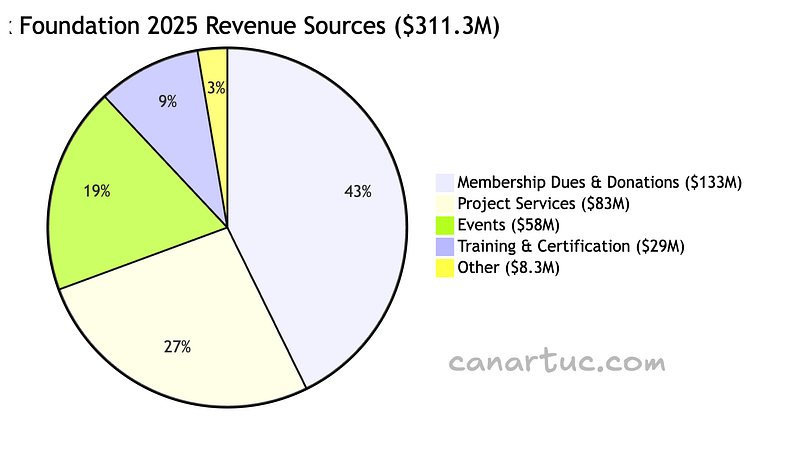
Membership dues and donations: $133 million (43%). This is the foundation’s bread and butter. Companies like Google, Microsoft, Intel, and Meta pay significant annual fees for platinum membership. They’re essentially paying for a neutral home for collaborative development.
Project services: $83 million (27%). This covers the technical infrastructure, staffing, and governance support for projects under the foundation umbrella.
Events: $58 million (19%). Open Source Summit, KubeCon, and other conferences. Events are revenue generators, not just community gatherings.
Training and certification: $29 million (9%). Linux certifications, Kubernetes certifications. This is growing steadily as enterprises formalize their open source hiring.
The Expense Side Is Where It Gets Interesting
Total expenses forecast around $299 million. The foundation runs lean for its size, with a projected $12 million surplus.
But here’s the allocation that made me uncomfortable.
Project support: $193 million. This sounds impressive until you learn it covers over 1,000 project communities. That’s around $193,000 average per project (though distribution is heavily weighted toward flagships like Kubernetes and Hyperledger).
Linux Kernel Project specifically: $8.4 million.
Let me repeat that. The kernel (the software that literally defines the organization’s name and runs most of the world’s infrastructure) receives $8.4 million out of $299 million in expenses.
That’s 2.8%.
I am a human writer who gets motivated to write more with your support! You don’t need to pay. I just need your clap 👏 if you like my story and comment ✍️ if you want to say something. You can follow me on Medium, LinkedIn, Instagram and X.
Is This a Problem or Strategic Brilliance?
I’ve thought about this because I’ve seen how funding decisions shape technology trajectories.
There are two ways to interpret the Linux Foundation’s allocation.
The charitable interpretation: The Linux kernel is mature. It has a well-established development process with thousands of corporate contributors (Intel, Red Hat, Google, and others) who pay their own developers. The foundation doesn’t need to fund kernel work directly because the ecosystem self-sustains. Instead, the foundation strategically invests in emerging areas where the market hasn’t yet been served.
The cynical interpretation: The foundation has become a project incubator that happens to carry the Linux name. It chases the latest trends (AI, blockchain, cloud native) while the foundational infrastructure that makes everything possible gets the equivalent of pocket change.
The truth is probably somewhere between.
The Foundation Model Trade-off
Here’s what I’ve learned about foundation economics from watching this space for two decades.
The foundation model creates a paradox. You need corporate money to survive. Corporate money follows enterprise trends. Enterprise trends chase the shiny.
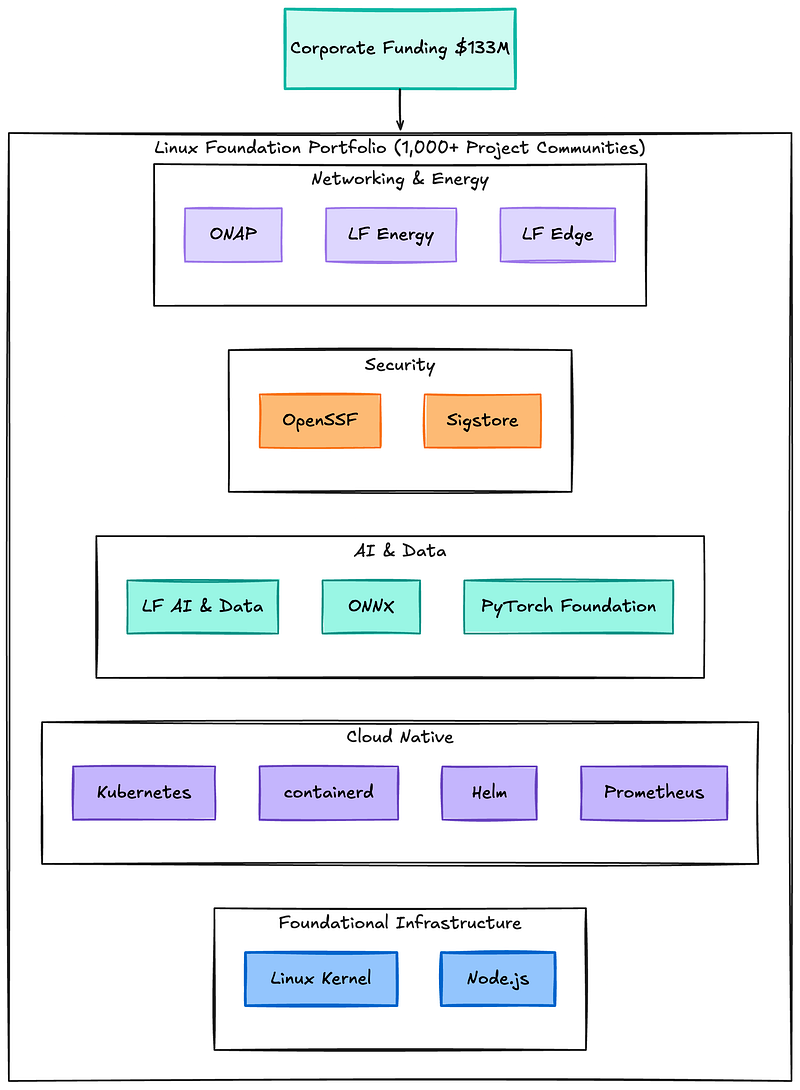
The Linux Foundation’s diversified portfolio spans AI (LF AI & Data, PyTorch Foundation), cloud native (CNCF with Kubernetes), security (OpenSSF), networking (ONAP), energy (LF Energy), and digital public goods.
This diversification serves three purposes:
Risk management: Not dependent on any single project or corporate sponsor
Relevance: Staying connected to where enterprise investment flows
Network effects: Projects under one umbrella can share governance models, legal frameworks, and operational infrastructure
But there’s a cost. Attention is finite. Staff is finite. When you manage over 1,000 project communities, how much focus can any single project (even the kernel) receive?
What the Market Is Actually Funding
Look at what $311 million buys across the ecosystem.
The CNCF (Cloud Native Computing Foundation, a Linux Foundation project) alone likely consumes a significant chunk of the project services budget. KubeCon is one of the largest developer conferences globally. Kubernetes certification is probably the fastest-growing certification program in the training portfolio.
Cloud native is where the money is because cloud native is where enterprise spending is.
Meanwhile, the kernel ticks along. It works. It’s maintained. But it’s not attractive. It doesn’t have a marketing budget or an annual conference (embedded conferences exist, but nothing at KubeCon scale).
This reflects a broader truth about open source economics: mature infrastructure gets undervalued because it’s invisible. Nobody thinks about the kernel until something breaks.
The Sustainability Question
Here’s what actually concerns me.
The foundation model works when corporate interests align with community interests. Companies fund projects because they use them and want influence over their direction.
But what happens when corporate priorities shift?
AI is the current obsession. Cloud native is maturing. What comes next? Foundations that chased trends in 2015 (blockchain, anyone?) now manage projects with declining relevance.
The Linux kernel is different. It’s not trendy; it’s essential. It will be relevant in 20 years. Will the foundation structure that supports it look the same?
$8.4 million for the kernel works today because companies like Intel, Google, Red Hat, and Samsung fund their own kernel developers. But this creates a dependency on sustained corporate investment that’s not directly managed by the foundation.
If any major corporate contributor pulls back, the foundation doesn’t have the budget to compensate.
The Practical Takeaway
What does this mean if you’re building systems on Linux (which is essentially everyone)?
Understand the ecosystem structure: The Linux Foundation is an umbrella, not a singular entity. Different projects have different governance, different funding levels, and different health indicators.
Watch the trends: Where the foundation invests signals where enterprise open source is heading. AI and security are current priorities. Edge computing is growing. Kernel maintenance is assumed.
Contribute strategically: If your company depends on a specific project, consider contributing (code or funding). Don’t assume the foundation will keep everything healthy forever.
The kernel is fine (for now): Despite the seemingly low allocation, Linux kernel development is healthy. The funding model is just distributed across corporate contributors rather than centralized through the foundation.
Final Thoughts
Breaking $300 million is a milestone worth celebrating. The Linux Foundation has proven that open source can be economically sustainable at scale.
But the allocation tells a story about priorities. An organization called the Linux Foundation now functions primarily as a project incubator and neutral ground for enterprise collaboration. The kernel itself is almost incidental to the business model.
Is that a problem? Maybe not. The kernel works. Development continues. Corporate investment flows.
But I’d feel more comfortable if the foundational infrastructure received proportional attention to its importance. $8.4 million for the software that runs 100% of the world’s top supercomputers feels like an afterthought.
Then again, maybe that’s exactly how open source should work. The community maintains what matters. The foundation provides the umbrella. The money follows the trends.
After 20+ years in this industry, I’ve learned that nothing is permanent. Not even the assumptions we make about how critical infrastructure gets funded.
What’s your take on foundation economics? Does the diversified model make sense, or should organizations like the Linux Foundation focus more narrowly on their namesake projects? Looking forward to reading your perspective in the comments.
I am a human writer who gets motivated to write more with your support! You don’t need to pay. I just need your clap 👏 if you like my story and comment ✍️ if you want to say something. You can follow me on Medium, LinkedIn, Instagram and X.