
Linux Enterprise AI Infrastructure: Agentic AI Foundation + AMD ROCm Convergence
Linux Foundation launches Agentic AI Foundation with AWS, Google, Microsoft, Anthropic, and OpenAI. Ubuntu adds AMD ROCm support. December…

Linux Foundation launches Agentic AI Foundation with AWS, Google, Microsoft, Anthropic, and OpenAI. Ubuntu adds AMD ROCm support. December 2025 changes the enterprise AI strategy.
Two announcements. One week. Enterprise AI infrastructure will never be the same. The Linux Foundation just launched the Agentic AI Foundation with every major AI company on board. Canonical announced Ubuntu 26.04 will officially package AMD ROCm, breaking NVIDIA’s monopoly.
December 2025 marks the moment Linux became the definitive platform for enterprise AI.
Not through marketing. Not through hype. Through two concrete announcements that solve real problems I have faced for years: vendor lock-in and GPU monopoly pricing.
I have been building edge-to-cloud systems since 2008, before the tools matured. I architected 14 GDPR- and ISO 27001-compliant platforms across telecommunications, digital health, media, conversational AI, and deep-tech imaging. In that time, I watched organizations spend millions on proprietary AI stacks that trapped them with a single vendor.
December 2025 changes that calculus completely.
The Two Announcements
The Linux Foundation announced the Agentic AI Foundation, a neutral governance body for AI agent technologies. The founding members read like an AI industry summit: AWS, Google, Microsoft, Anthropic, OpenAI, Block, Bloomberg, Cloudflare.
Three core projects were donated:
Model Context Protocol (MCP) from Anthropic, a universal standard for AI-to-tools connectivity already deployed on 10,000+ servers
goose from Block, a local-first AI agent framework emphasizing security
AGENTS.md from OpenAI, a markdown-based agent behavior guidance specification active in 60,000+ projects
Simultaneously, Canonical announced Ubuntu 26.04 LTS (April 2026) will package and maintain AMD ROCm in its official repositories. While RHEL and SLES already support AMD ROCm through AMD-provided external repositories, Ubuntu’s approach simplifies installation to a single apt install command—mirroring what they did with NVIDIA CUDA in September 2025.
If this sounds like infrastructure plumbing, you are missing the strategic implications. Let me break them down.
I am a human writer who gets motivated to write more with your support! You don’t need to pay. I just need your clap 👏 if you like my story and comment ✍️ if you want to say something. You can follow me on Medium, LinkedIn, Instagram, and X.
Why Agentic AI Foundation Matters
The Agentic AI Foundation is not another consortium announcement. It solves a specific problem that has been costing enterprises millions.
AI agents need to connect to tools. Every major provider built their own connection standard. Function calling for OpenAI. Tool use for Anthropic. Custom integrations for everyone else. I have seen teams spend months building adapter layers between agent frameworks and enterprise tools.
MCP changes this equation.
Model Context Protocol provides a universal standard. One integration works across providers. When Anthropic donates this to a neutral foundation with Microsoft, Google, and OpenAI as founding members, that is not altruism. That is industry recognition that fragmentation hurts everyone.
If this resonates with your enterprise integration pain, clap so other architects can find this analysis.
The goose framework from Block addresses a different problem: security. Most AI agent frameworks assume cloud-first deployment. Enterprise AI often needs local execution for compliance, latency, or cost reasons. Block built goose for exactly this use case, and now it is under neutral governance.
AGENTS.md from OpenAI tackles the behavior specification problem. When you have 60,000+ projects using a markdown-based standard for agent behavior, that is de facto industry adoption before formal standardization. Smart move by OpenAI to donate this rather than fight competing standards.
Ubuntu AMD ROCm: Breaking the GPU Monopoly
The second announcement is equally significant but gets less attention.
NVIDIA has maintained GPU monopoly for AI workloads through CUDA. Not because CUDA is technically superior (it is excellent), but because every major Linux distribution defaulted to NVIDIA drivers. AMD’s ROCm required manual installation, community support, and hope.
Ubuntu 26.04 changes this.
Official packaging means apt install works. Enterprise support contracts cover it. Certification paths exist. For the first time, CTOs can choose AMD GPUs for AI workloads without betting on community maintenance.
ROCm 7.0 features matter for production:
PyTorch 2.7/2.8 support
TensorFlow 2.19.1 support
JAX 0.6.x support
FP4/FP6/FP8 precision support for inference optimization
AMD MI350 series becomes a viable alternative to NVIDIA H100/H200. Cost savings of 20–30% compared to NVIDIA are real. Open-source drivers (GPL/MIT) versus proprietary CUDA stack changes risk calculations.
Have your organization evaluated AMD GPUs for AI workloads? Tell me in the comments what blocked adoption.
The Convergence Point
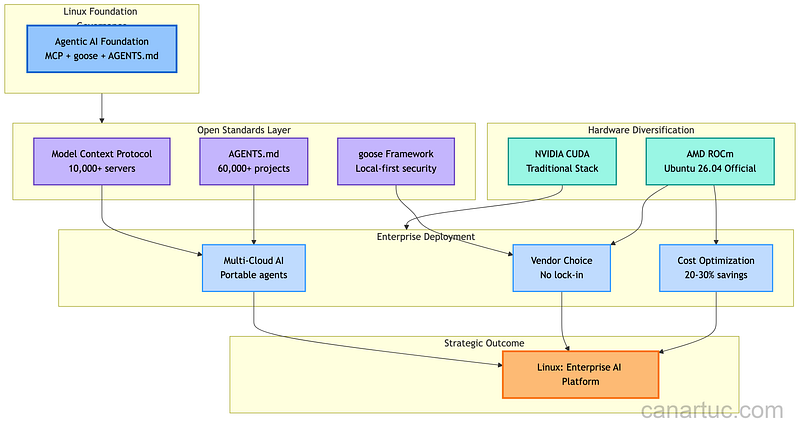
These two announcements reinforce each other in ways that matter strategically.
Standardization (Agentic AI Foundation) plus vendor diversification (AMD ROCm) equals reduced enterprise risk. Open-source governance plus open-source hardware drivers equals strategic independence.
Consider the practical implications:
Multi-cloud AI deployment becomes viable. MCP provides agent portability. AMD ROCm provides GPU portability. Your AI workloads no longer lock into single vendors at either the software or hardware layer.
Cost negotiation leverage improves. When AMD is a credible alternative, NVIDIA pricing power decreases. When MCP standardizes integrations, switching between AI providers becomes feasible. Procurement teams gain leverage they have not had.
Compliance paths simplify. Open-source drivers mean auditable code. Neutral governance means no single vendor controls your AI infrastructure standards. After architecting 14 compliant platforms, I can tell you: auditors love open-source stacks with clear governance.
Ecosystem Comparison
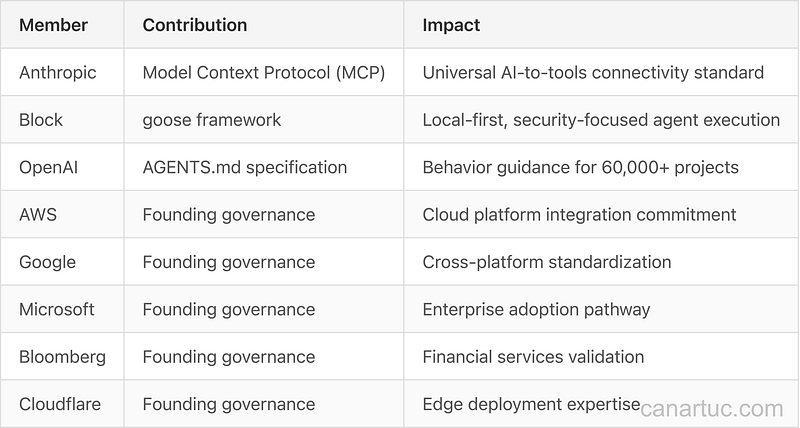
The founding member composition tells you something important: competitors are cooperating on infrastructure. This only happens when fragmentation costs exceed competitive advantage from proprietary standards.
Timeline and Implications
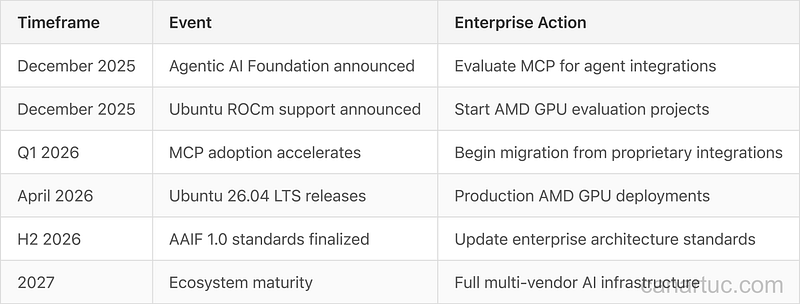
The timeline matters for planning. Ubuntu 26.04 LTS releases April 2026. That gives enterprises 16 months to evaluate AMD GPUs, test ROCm workloads, and plan migrations.
Agentic AI Foundation standards will mature throughout 2026. Early adopters gain integration experience before competitors.
Decision Matrix for Adoption
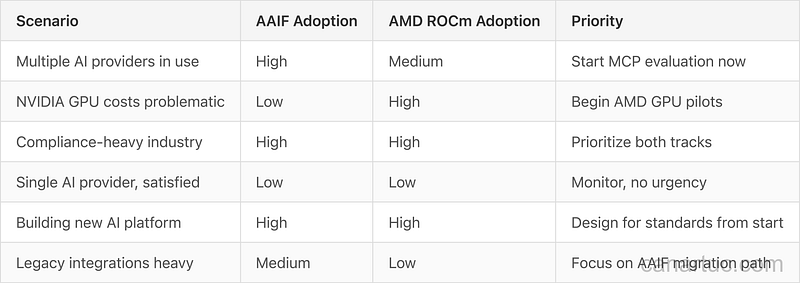
When to adopt aggressively: you are using multiple AI providers, facing GPU cost pressure, or operating in compliance-heavy industries. These organizations see immediate returns from standardization and vendor diversification.
When to wait: you have a single AI provider relationship that works, NVIDIA GPU costs are acceptable, and legacy systems are stable. The standards will mature; you can adopt later without disadvantage.
Infrastructure transitions happen slowly, then all at once. Organizations that wait for “maturity” often find themselves two years behind competitors who started evaluations early.
Strategic Recommendations
For CTOs and VPs of Engineering:
Immediate (Q1 2026):
Evaluate MCP for one production AI integration
Request AMD GPU samples for inference testing
Update 2026 AI infrastructure budgets with AMD alternatives
Medium-term (2026):
Migrate two to three integrations to MCP
Run parallel AMD/NVIDIA workloads for cost comparison
Establish (if you want Ubuntu) Ubuntu 26.04 LTS as AI infrastructure baseline
Long-term (2027+):
Standardize on AAIF specifications for all new agent deployments
Implement multi-vendor GPU strategy
Build procurement leverage through vendor optionality
For Platform Engineers and Architects:
Immediate:
Study MCP specification and reference implementations
Set up AMD ROCm development environments
Test goose framework for local agent execution
Medium-term:
Build MCP adapters for critical enterprise tools
Benchmark AMD MI350 against H100 for your workload profiles
Contribute to AAIF standards where your expertise applies
The Bigger Picture
Open standards win. Eventually. But the winners are organizations that adopt during the transition, not after industry consensus is obvious.
Linux became the enterprise server standard because it provided freedom from vendor lock-in. December 2025 marks the moment Linux extends that value proposition to enterprise AI infrastructure.
The organizations that plan 2026 AI infrastructure assuming these standards will succeed position themselves for the future. Those waiting for certainty will pay the price in lock-in, premium pricing, and integration complexity.
What is your organization’s timeline for evaluating these December 2025 announcements? Are you planning 2026 infrastructure with vendor optionality in mind?
I am a human writer who gets motivated to write more with your support! You don’t need to pay. I just need your clap 👏 if you like my story and comment ✍️ if you want to say something. You can follow me on Medium, LinkedIn, Instagram, and X.