
Linux Desktop Market Share: From Hype Cycles to Sustained Growth
Linux crossed 4% global market share and held it for three months. After 20 years of false starts, the data suggests something…

Linux crossed 4% global market share and held it for three months. After 20 years of false starts, the data suggests something fundamentally different.
Three months. Four percent.
I have been writing about Linux for over two decades. Every few years, someone declares the “Year of the Linux Desktop.” Every time, the numbers spike briefly, then retreat.
This time looks different.
The Numbers That Made Me Pay Attention
StatCounter’s December 2024 data shows Linux at 3.86% global desktop market share. That does not sound revolutionary until you understand the context.
Linux has maintained above 3% for three consecutive months now. Before 2024, crossing 3% was a single-month anomaly. The kind of statistical noise you learn to ignore.
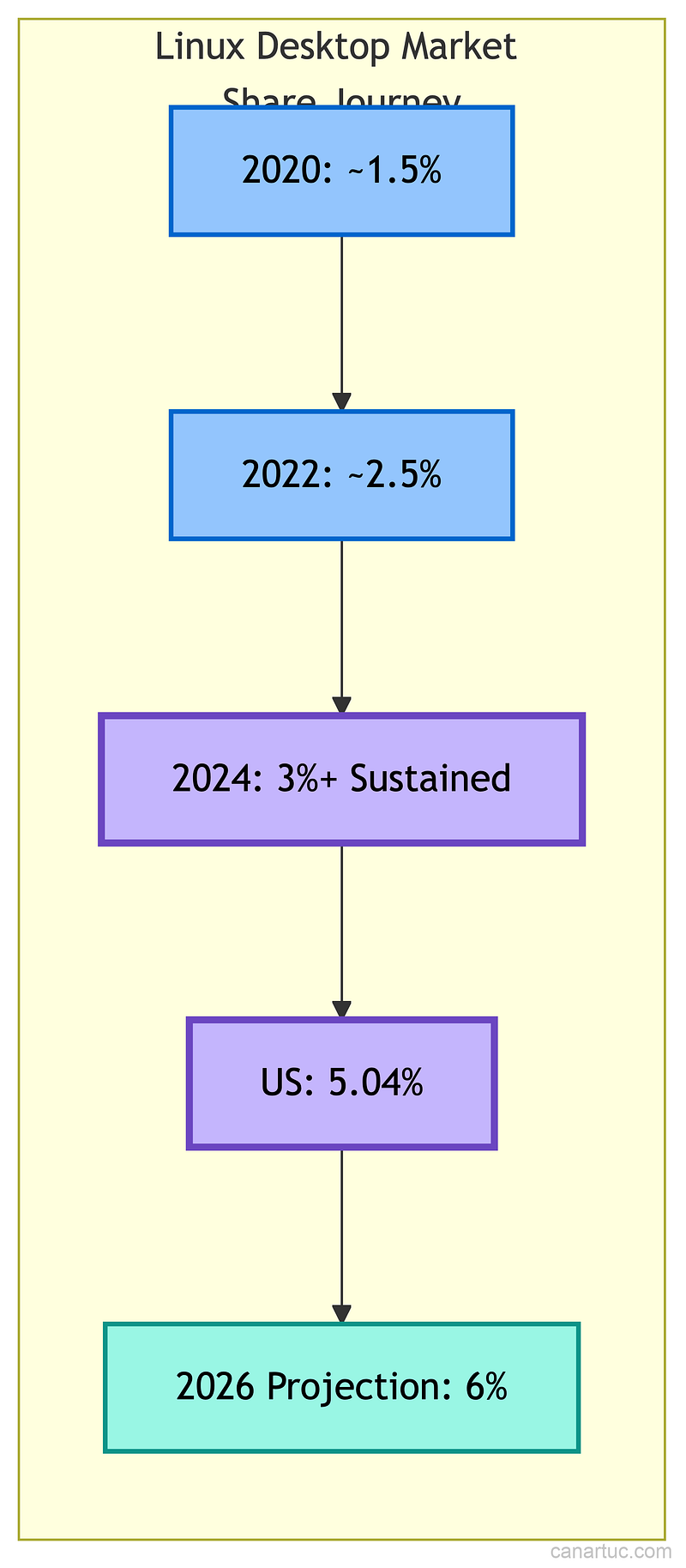
The US numbers project an even more interesting story. Trends suggest Linux is positioned to reach approximately 5% market share in the US by mid-2025. This would be the first time Linux crossed 5% in any major market. Not a spike. A sustained climb.
What changed?
I am a human writer who gets motivated to write more with your support! You don’t need to pay. I just need your clap 👏 if you like my story and comment ✍️ if you want to say something. You can follow me on Medium, LinkedIn, Instagram and X.
Three Drivers That Are Not Going Away
I have watched enough Linux hype cycles to know the pattern. A new distribution gets attention. A hardware vendor ships Linux preinstalled. Enthusiasts celebrate. Then nothing changes for regular users, and the numbers fade.
The current growth comes from three sources that are structural, not promotional.
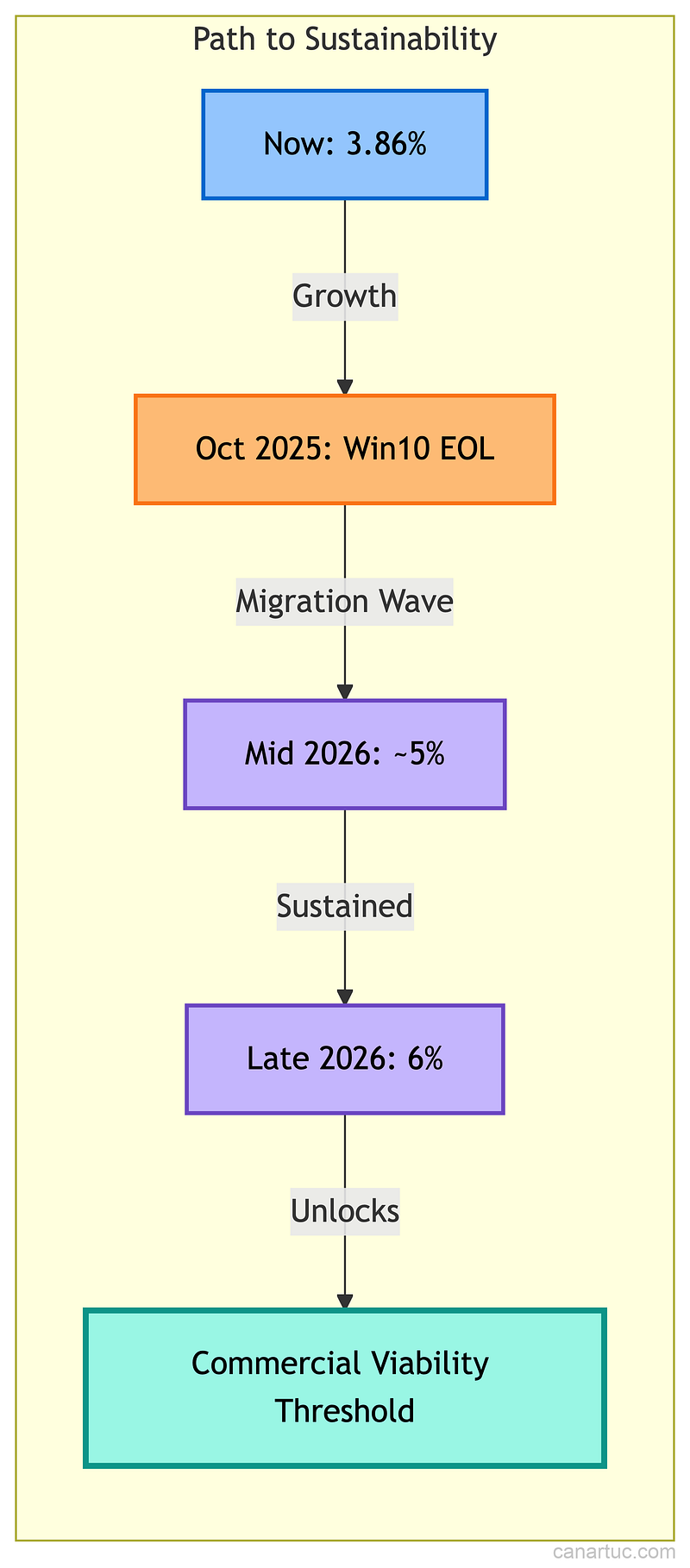
First, Windows 10 reaches end-of-life in October 2025. Microsoft will stop security updates for an operating system running on hundreds of millions of machines. Many of those machines cannot upgrade to Windows 11 due to TPM 2.0 requirements.
These users face three choices: buy new hardware, run an unsupported operating system, or try something else. Linux becomes the practical choice for hardware that works perfectly fine except for an arbitrary security chip requirement.
Second, Steam Proton actually works now. Valve has spent years making Windows games run on Linux through their Proton compatibility layer. Steam hardware surveys showed Linux gaming at 2.29% in December 2024, with later surveys reaching 3.58%. More importantly, most new games simply work without configuration.
Gaming was the last major barrier for desktop Linux. Not anymore.
Third, privacy concerns have shifted from theoretical to visceral. Windows 11 telemetry has become increasingly aggressive. The AI features in recent updates require sending data to Microsoft servers. Users who previously tolerated this are reconsidering.
If you find this story useful, a clap helps more people discover it.
Why I Think This Time Is Different
I have been wrong about Linux desktop adoption before. Twice, specifically.
Once around 2005 when Ubuntu seemed poised to break through. Again around 2015 when Chrome OS validated the idea that non-Windows could work for regular users.
Both times, I underestimated how sticky Windows defaults are.

What makes 2024 different is that the drivers are forcing functions, not feature comparisons.
Previous adoption attempts asked users to choose Linux because it was better. That is a weak motivator when Windows works fine and comes preinstalled.
Current adoption is being pushed by external deadlines. Windows 10 users do not get to keep using what works. They must act. When the choice is “spend a minimum of $800 on a new laptop or try Linux on hardware you already own,” the calculation changes.
The gaming compatibility removes the biggest objection I used to hear. “I would switch but I need Windows for games.” That objection is now false for most users.
The Distributions That Are Actually Growing
Not all Linux distributions benefit equally from this shift.
Linux Mint continues to capture Windows refugees because it prioritizes familiarity over ideology. The interface looks enough like Windows that the transition feels manageable.
Arch-based distributions like EndeavourOS are growing among the technical audience. These users want control and transparency. They are specifically leaving Windows because of telemetry concerns, so they choose distributions that respect that preference.
Ubuntu remains the name recognition leader, but its own telemetry controversies and Snap package decisions have created hesitation among privacy-motivated switchers.
Enjoyed this so far? Leave a clap before you forget.
My Prediction: 6% by Late 2026
Based on the current trajectory and the Windows 10 EOL deadline, I expect Linux to reach 6% global desktop market share by late 2026.
That is still a minority position. MacOS will still be larger. Windows will still dominate enterprise and consumer markets.
But 6% is the threshold where software vendors start caring. Where more commercial applications get native Linux support. Where the ecosystem becomes self-reinforcing rather than dependent on heroic volunteer effort.
What This Means for You
If you have been curious about Linux but waiting for “the right time,” the next eighteen months present a unique window.
The tooling has never been better. The compatibility layer for Windows applications has never been more capable. The community has never been larger or more helpful.
You do not need to wait for the “Year of the Linux Desktop.” It is not coming as a single moment of arrival. What is happening instead is gradual, structural growth driven by external forces rather than internal evangelism.
That is actually more sustainable.
What is your prediction for 2026? I look forward to your numbers in the comments below.
I am a human writer who gets motivated to write more with your support! You don’t need to pay. I just need your clap 👏 if you like my story and comment ✍️ if you want to say something. You can follow me on Medium, LinkedIn, Instagram and X.