Is OpenAI ready for enterprise customers like Apple?
OpenAI is a superstar of the new AI era with ChatGPT and Dall-E, including management drama that happened recently
There is no secret that Apple will embed OpenAI into iPhone (specifically Siri), at least what we heard recently: https://www.theverge.com/2024/6/10/24174786/apple-openai-partnership-chatgpt-wwdc.
When I first heard the news, I was unsure that OpenAI was ready for an enterprise company of this size. I have felt all these times with OpenAI, specifically ChatGPT, that they are very much startups without software engineering skills. Nobody doubts their AI skills and models (at least, they are the top ones now), but AI itself is not only so meaningful for B2B and B2C customers because you need to have software engineering skills to get the request and serve it properly. Although Google’s Gemini is worse than ChatGPT, Google’s software engineering skills are way better, by no surprise.
I have been in the data field for around 16 years. Even as a software engineer, I dealt with high-volume distributed systems. As a result, I checked several bullet points regarding software engineering at the enterprise level.
Technology Advancements
This is the first reason that OpenAI is very much a startup.
According to reports, OpenAI, the company behind ChatGPT, approached Scarlett Johansson to use her voice for the AI chatbot. However, Johansson declined the offer, citing concerns about using her voice without consent. Despite this, OpenAI released the voice mode, which some users have likened to Johansson’s voice.
OpenAI has maintained that the voice is not an imitation of Johansson’s voice but rather a natural voice created by a different professional actress. The company has also emphasized that the voice is not meant to be a clone of Johansson’s voice but rather a unique voice designed to provide a human-like interaction with users.
Johansson has expressed her shock and anger over the release of the voice mode, stating that she was “shocked, angered, and in disbelief” that OpenAI would pursue a voice that sounded similar to hers. She has also emphasized the importance of protecting her intellectual property and the need for consent when using someone’s voice.
In the end, OpenAI removed the “Sky” voice from ChatGPT.
Scalability and Reliability
If you use ChatGPT frequently, even with the paid (plus) account, you can realize that you are not getting answers or getting errors often. I didn’t count personally, but ChatGPT is not always there when needed. So we can eliminate scalability. It is not a reliable source because OpenAI also mentions that the results can be wrong. There is a detailed test here if you are interested in: https://www.fm-magazine.com/news/2024/may/chatgpt-use-cases-and-limits-to-its-reliability.html.
Security and Privacy
Oh, this is my favourite topic, and OpenAI screwed very heavily.
In 2023, OpenAI, the creator of ChatGPT, experienced a hack where its internal messaging system was breached. Hackers could access employee chats but not the AI code. This incident was not reported to the FBI. OpenAI employee Leopold Aschenbrenner raised concerns but was later dismissed. OpenAI and other AI firms have since commissioned studies on potential national security risks. Source: https://www.nytimes.com/2024/07/04/technology/openai-hack.html
Customization and Integration
This is another item for which OpenAI failed very heavily. They opened the ChatGPT store as customized GPTs, but I haven’t seen an actual usage of it. For example, there is a Book GPT that can recommend your next book based on your commands, but I can also get the result with ChatGPT. It is the same for the GPTs, which give recipes, coding studies, etc. Whatever they can do, ChatGPT can also do it, so why should I use “customized” GPT?
The second one is integration. Especially in the enterprise, there are integration patterns, requirements and standards. Let’s check OpenAI’s Mac App integration from the news: https://arstechnica.com/ai/2024/07/chatgpts-much-heralded-mac-app-was-storing-conversations-as-plain-text/
OpenAI released a Mac desktop app for ChatGPT, but it initially stored user chats as plain text. Pedro José Pereira Vieito highlighted this security issue, noting that any running app could read the chats without permission. OpenAI has since updated the app, encrypting local chats, although they are still not sandboxed. The app is unavailable on Apple’s App Store, where more stringent security measures are in place. Users using the app are advised to update it as soon as possible. It is a great exercise to learn how OpenAI handles software quality checking with standards and security aspects.
Ethical Considerations
When you integrate a third-party system into your infrastructure, you also take their burdens with you. In this case, Apple will display ChatGPT results in Siri. Any regular customer doesn’t know what the behind is, so for them, it is Apple.
The New York Times sues OpenAI: https://www.nytimes.com/2023/12/27/business/media/new-york-times-open-ai-microsoft-lawsuit.html
Is the New York Times the only one? Of course not; there are more: https://www.cnbc.com/2024/04/30/eight-newspaper-publishers-sue-openai-over-copyright-infringement.html
Should We Get Apple Products in the Future?
I am using an iPhone just because of security reasons. The technology is already developed for smartphones; in fact, Apple competitors are providing better hardware than Apple, including a camera.
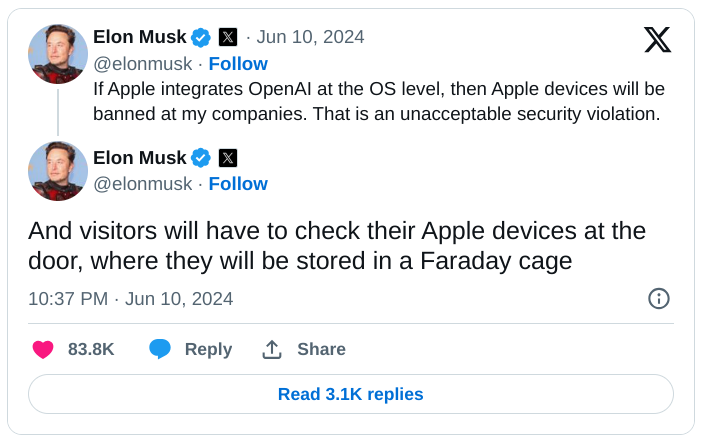
Although I don’t agree with everything he says, this time, I am with Elon Musk, and I don’t think that Apple is doing well with OpenAI integration: