
FreeBSD Laptop Support: Why Linux Shouldn’t Get Comfortable
FreeBSD delivered Wi-Fi 4/5, new power management, and Modern Standby in 2025. Monthly GitHub updates shame Linux’s opacity. Your laptop…

FreeBSD delivered Wi-Fi 4/5, new power management, and Modern Standby in 2025. Monthly GitHub updates shame Linux’s opacity. Your laptop options just expanded.
Server stronghold. Desktop desert.
That’s been FreeBSD’s reality for decades.
One year ago, the FreeBSD Foundation launched a dedicated laptop usability campaign. Critics laughed. “FreeBSD on laptops” had been a punchline since the early 2000s.
The critics stopped laughing. Wi-Fi now works. Power management improved dramatically. And monthly GitHub updates track every milestone with surgical transparency.
FreeBSD just demonstrated something the Linux community should study carefully.
If you find this perspective valuable, please consider a clap.
The 2025 Delivery Report Card
Let’s talk specifics. Not marketing claims. Actual shipped features.
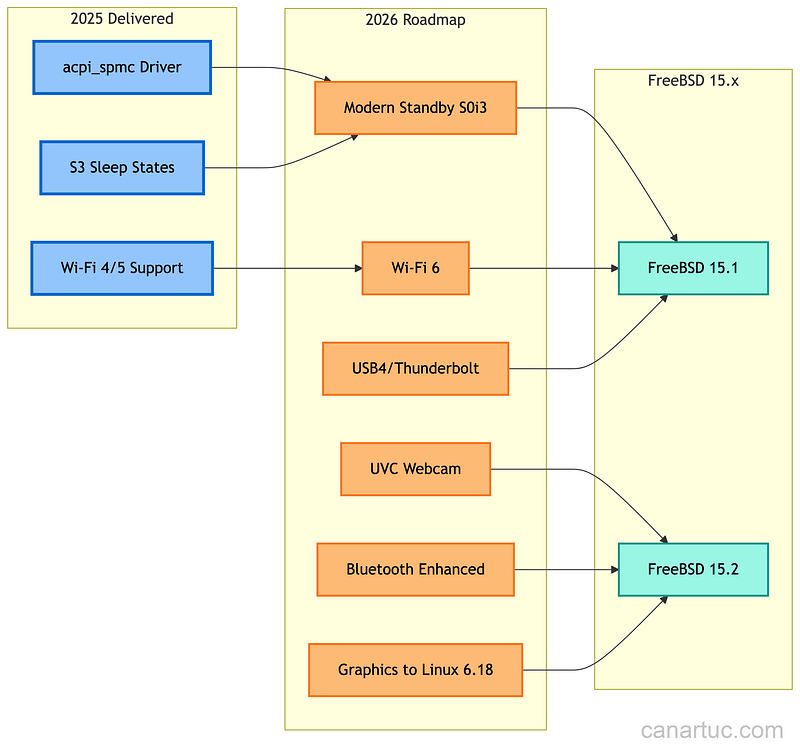
Wi-Fi 4/5 support: Functional. Not “mostly works” or “requires manual configuration.” Actually functional on supported chipsets.
acpi_spmc driver: New power management driver enabling deeper sleep states. This matters for laptop battery life.
S3 sleep states: Traditional suspend working reliably on more hardware.
The pattern here matters. Each deliverable built foundation for the next. This is engineering discipline, not random feature accumulation.
I am a human writer who gets motivated to write more with your support! You don’t need to pay. I just need your clap 👏 if you like my story and comment ✍️ if you want to say something. You can follow me on Medium, LinkedIn, Instagram and X.
The Transparency Difference
Here’s where FreeBSD embarrasses much of the Linux ecosystem.
Monthly progress reports. Published on GitHub. Specific milestones. Clear accountability.
I’ve coordinated 3,000+ technology professionals across major transformation programs. I know what transparent project management looks like. FreeBSD Foundation’s laptop campaign runs like enterprise software development should run.
Compare this to how most Linux development communicates. Kernel patches appear. Mailing list threads sprawl. Users piece together what might land in which release from scattered sources.
FreeBSD’s approach: “Here’s what we promised. Here’s what we delivered. Here’s what’s next. Here are the blockers.”
That level of transparency builds trust. And trust converts skeptics into users.
The 2026 Roadmap Ambitions
Modern Standby (S0i3) expected in FreeBSD 15.1.
This is significant. Modern laptops increasingly deprecate traditional S3 sleep in favor of S0i3. Without S0i3 support, any operating system becomes a second-class citizen on current hardware.

Wi-Fi 6 in active development. Not “someone should work on this” but actively being implemented with milestone tracking.
USB4 and Thunderbolt support planned. Graphics driver parity with Linux 6.18 targeted.
UVC webcam support addresses a critical gap. Remote work made webcam support mandatory, not optional. FreeBSD currently lacks this. The roadmap addresses it.
Hibernation (S4) targets FreeBSD 15.2. Full power-off state with session preservation.
Where Linux Still Dominates
I’m not claiming FreeBSD suddenly matches Linux for laptop usability.
Linux has decades of hardware vendor relationships. OEMs ship Linux preinstalled. Canonical and Red Hat negotiate directly with Intel, AMD, and NVIDIA. Driver support arrives quickly because vendors have financial incentives to participate.
FreeBSD lacks that ecosystem. No major laptop vendor ships FreeBSD. Hardware support depends almost entirely on volunteer and Foundation efforts.
Gaming remains a Linux advantage. Proton, Steam Deck integration, Vulkan driver maturity. FreeBSD can’t compete here currently.
Wireless networking, despite 2025 improvements, still favors Linux. More chipsets supported. Faster driver updates. Better firmware availability.
What FreeBSD Gets Right
The BSD license philosophy attracts specific users. Companies can build proprietary products on FreeBSD (PlayStation uses FreeBSD-based Orbis OS; other systems incorporate BSD code) without GPL obligations.
ZFS integration remains superior. FreeBSD’s native ZFS support predates Linux’s third-party implementations by years. For data integrity focus, FreeBSD still leads.
jails (containerization predecessor) provide mature isolation without the complexity explosion of container ecosystems.
Networking stack maturity benefits infrastructure use cases. Netflix runs FreeBSD for content delivery. Not because it’s trendy but because the network stack performs.
The Strategic Calculation
FreeBSD Foundation made a strategic bet. Server dominance wasn’t enough for long-term relevance. Desktop (specifically laptop) viability became necessary for ecosystem health.

Developer recruitment requires viable daily-driver potential. If developers can’t use FreeBSD on their personal laptops, they’re less likely to contribute.
User pipeline depends on accessibility. Server administrators who never experience FreeBSD won’t recommend it for production.
The laptop campaign addresses ecosystem health, not just feature checkboxes.
Should You Try FreeBSD on Your Laptop?
Honest assessment time.
Try FreeBSD if: You have specific supported hardware (check the hardware notes), you value ZFS, you want BSD licensing, or you’re genuinely curious about alternatives. The improvements are real.
Stick with Linux if: You need broad hardware compatibility, rely on specific proprietary drivers, depend on gaming, or require zero configuration effort. Linux’s ecosystem advantages remain substantial.
Consider dual-booting: Test FreeBSD’s laptop improvements without commitment. See how your specific hardware performs.
I’ve tested numerous operating systems across 20+ years. The capable operating systems survive by finding niches and expanding carefully. FreeBSD found its server niche. Now it’s testing whether desktop expansion is viable.
The 2025 results suggest the answer might be yes.
What Linux Should Learn
Competition improves everyone. FreeBSD’s transparent development process, monthly milestone reporting, and clear roadmap communication represent standards Linux distributions could adopt.
When a competitor demonstrates better practices, the appropriate response is learning, not dismissal.
FreeBSD just proved that focused engineering effort can overcome decades of perception problems. The laptop gap is closing.
Linux shouldn’t panic. But it also shouldn’t get comfortable.
Please share your FreeBSD experiences in the comments. Have you tested FreeBSD on modern laptop hardware?
I am a human writer who gets motivated to write more with your support! You don’t need to pay. I just need your clap 👏 if you like my story and comment ✍️ if you want to say something. You can follow me on Medium, LinkedIn, Instagram and X.