
DRM Color Pipeline API and HDR on Linux: The Long Road to Proper Display Color Management
The DRM Color Pipeline API merged to drm-misc-next in November 2025 and is included in Linux kernel 6.19-rc1 (December 2025) after years of…

The DRM Color Pipeline API merged to drm-misc-next in November 2025 and is included in Linux kernel 6.19-rc1 (December 2025) after years of development by AMD, Igalia, and Valve. HDR gaming on Steam Deck gets proper color management.
Years in the making. Multiple stakeholders. Zero shortcuts.
The DRM Color Pipeline API merged to drm-misc-next on November 26, 2025, and is included in Linux kernel 6.19-rc1. If you care about HDR gaming on Linux (especially on Steam Deck), this matters more than any single driver update in recent memory.
The Problem with Linux Color Management
Let me tell you something about display color management on Linux.
It was a mess.
Every GPU vendor implemented their own approach. Every compositor had different assumptions. If you wanted proper HDR output, you were basically hoping that your specific combination of hardware, driver, and desktop environment happened to align correctly.
I can tell you: fragmentation like this kills user experience.
The gaming community felt it most acutely. You buy an HDR monitor, connect it to your Linux machine with a capable AMD GPU, and… nothing works as expected. Colors look washed out. HDR content doesn’t display correctly. The pipeline between your application and your display was essentially a black box with no standardized controls.
If you’ve dealt with this frustration, clap so other Linux users can find this article.
What the Color Pipeline API Actually Does
The DRM Color Pipeline API standardizes how color transformations happen in the graphics stack. Think of it as creating a common language that GPUs, compositors, and applications can all speak.

The multi-stage pipeline includes:
Degamma LUT: Converts non-linear input to linear space
Color Transform Matrix (CTM): Applies color space conversions
Gamma LUT: Applies output gamma curve
HDR Metadata: Handles HDR10, HLG, and other standards
Before this API existed, each GPU vendor implemented these stages differently. AMD had one approach. Intel had another. NVIDIA’s proprietary driver did its own thing. Compositors had to implement separate code paths for each vendor.
That fragmentation ends now.
I am a human writer who gets motivated to write more with your support! You don’t need to pay. I just need your clap 👏 if you like my story and comment ✍️ if you want to say something. You can follow me on Medium, LinkedIn, Instagram, and X.
The Valve and Steam Deck Connection
Let’s talk about who actually drove this forward.
AMD, Igalia, and Valve. That’s the core team. And if you understand Valve’s strategy, this makes perfect sense.
Steam Deck runs Linux. Valve’s Gamescope compositor powers the gaming experience. For proper HDR gaming on Steam Deck, they needed standardized color management that works across the board.
This wasn’t a theoretical exercise. It was driven by real hardware shipping to millions of users.
The work focused heavily on AMD DCN 3.0+ GPUs (which power Steam Deck and newer AMD graphics cards). The initial kernel support covers:
AMD DCN 3.0+ GPUs (Steam Deck, Radeon RX 6000/7000 series)
VKMS (Virtual KMS) for testing and development
Valve’s Gamescope compositor already implements support. KWin (KDE’s compositor) and Weston (Wayland reference compositor) are following.
Have you tried HDR on Linux before this API landed? What was your experience?
Timeline: From Development to Mainstream
Here’s the reality of infrastructure changes in open source.
Years. It takes years.
The Color Pipeline API work started before 2023. Multiple patch series. Countless review cycles. Cross-vendor coordination between AMD, Intel, and the broader DRM community.
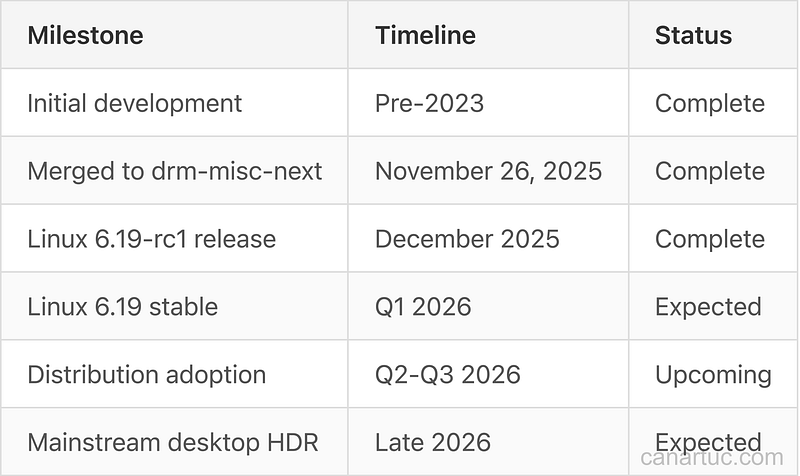
The merge to 6.19-rc1 is just the beginning. For this to reach regular users:
Linux 6.19 stable needs to release (expected Q1 2026)
Distributions need to adopt kernel 6.19+ (Fedora 44 in April 2026, Fedora 45 in October 2026)
Mesa drivers need corresponding updates
Compositors need to implement the API
Desktop environments need UI for HDR settings
Expect mainstream adoption around late 2026. That might sound far away, but for infrastructure changes of this magnitude, it’s actually quite fast.
Why This Matters Beyond Gaming
Gaming gets the headlines, but the implications extend further.
Creative professionals have long avoided Linux for color-critical work. Photography, video editing, design work all require accurate color reproduction. Without standardized color management, professionals couldn’t trust that what they saw on screen matched their output.
Display manufacturers can now target a standard API instead of implementing vendor-specific workarounds. This lowers the barrier for HDR monitor support on Linux.
Application developers get a clear target. Instead of implementing three different code paths for three GPU vendors, they can target one API.
After 20+ years in tech, I’ve learned that standards enable ecosystems. Individual vendor solutions, no matter how good, create fragmentation that ultimately hurts everyone.
The Technical Reality for Current Users
If you’re running a current stable distribution (Ubuntu 24.04 LTS, Fedora 43, or similar), you don’t have this yet. Linux 6.19 is in release candidate stage (6.19-rc1 released December 2025), with stable release expected Q1 2026. Distribution packages will take additional time.
What you can do now:
Follow Fedora Rawhide or rolling-release distributions for early access
Watch for Mesa updates corresponding to your kernel version
Ensure your compositor supports the new API (Gamescope users are ahead here)
Check that your display actually supports the HDR standards you’re targeting
Hardware requirements for full benefit:
AMD DCN 3.0+ GPUs (Radeon RX 6000 series and newer)
Steam Deck (all variants)
HDR-capable display with proper EDID reporting
Intel support is coming. NVIDIA support depends on their proprietary driver decisions (which is a whole separate topic I won’t get into here).
The Bigger Picture
This Color Pipeline API represents something larger than just HDR support.
It’s the Linux graphics stack maturing. It’s the Wayland ecosystem delivering on promises made years ago. It’s what happens when companies like Valve put real resources behind open source infrastructure.
Watching the Linux graphics stack evolve from a fragmented mess to a coordinated ecosystem is genuinely impressive.
The technologies that survive solve real problems, not those that merely feel comfortable. For HDR gaming and professional color work on Linux, this API solves a real problem that has frustrated users for years.
What Comes Next
The merge is complete. Now comes the hard work of adoption.
Watch for:
Linux 6.19 stable release (Q1 2026)
Fedora 44 (April 2026) or Fedora 45 (October 2026) shipping kernel 6.19+
KDE Plasma 6.x integrating Color Pipeline API support
GNOME following with their own implementation
Application-level HDR support becoming standard
For Steam Deck users specifically: Valve will likely push updates through SteamOS that enable this functionality relatively quickly. They have the most to gain and the tightest integration with the entire stack.
The long road to proper display color management on Linux is finally leading somewhere. Years of collaborative development between AMD, Igalia, Valve, and the broader kernel community are producing tangible results.
If you work on Linux graphics or you’re a Steam Deck user waiting for proper HDR, this is genuinely good news. Real infrastructure progress, not hype.
Are you tracking Linux 6.19 development? Are you planning to test HDR on Linux once kernel 6.19 stable releases? Share your setup in the comments.
I am a human writer who gets motivated to write more with your support! You don’t need to pay. I just need your clap 👏 if you like my story and comment ✍️ if you want to say something. You can follow me on Medium, LinkedIn, Instagram, and X.