
Conference-Driven Architecture Discourse: What QCon SF, SAG Berlin, and AWS re:Invent Tell Us About…
November 2025 broke records. Three major architecture conferences in two weeks. 150+ speakers.

Conference-Driven Architecture Discourse: What QCon SF, SAG Berlin, and AWS re:Invent Tell Us About 2026
Thousands of practitioners. And a crystal-clear signal about where our industry is heading.
I’ve sat through more conference talks than I can count. But this November felt different.
The convergence was undeniable.
After 20+ years in the trenches, I can spot when the industry is about to shift. This is one of those moments. Let me break down what these conferences are really telling us about the next phase of software architecture.
The Conference Landscape: A Rare Alignment
QCon SF (November 17–21) brought 104 speakers covering AI engineering, platform engineering, and reliability. Nicole Forsgren and Michelle Brush delivered keynotes that set the tone.
Software Architecture Gathering Berlin (November 24–27) assembled 40+ experts with a heavy AI focus. Gregor Hohpe’s “Drawing Like an Architect” and Barry O’Reilly’s “Residuality Theory” sessions stood out.
AWS re:Invent (starting November 28) emphasized resilience patterns, multi-region architecture, agentic AI, and digital sovereignty.
If you’ve been tracking architecture trends, clap so other architects can find this analysis.
Three conferences. Three continents. One unmistakable message.

I am a human writer who gets motivated to write more with your support! You don’t need to pay. I just need your clap 👏 if you like my story and comment ✍️ if you want to say something. You can follow me on Medium, LinkedIn, Instagram, and X.
Five Trends That Dominated Every Stage
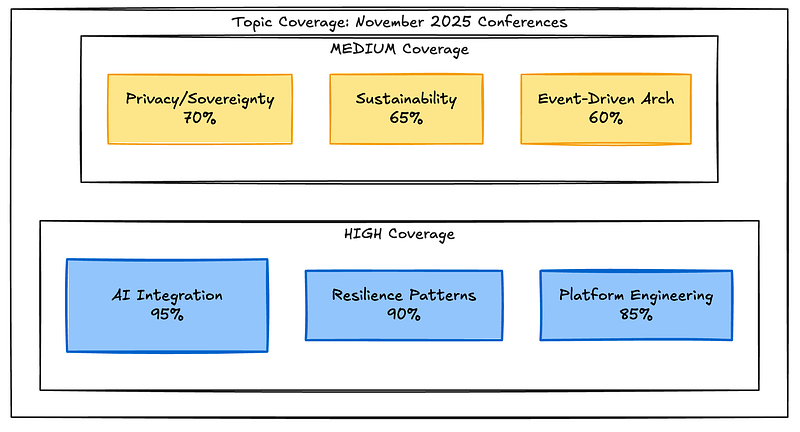
1. AI Is Now an Architectural Concern, Not Just a Feature
Every conference hammered this home. AI isn’t something you bolt on anymore.
At QCon SF, talks from Netflix on polyglot security and LinkedIn on billion-user recommendation migration showed how AI reshapes fundamental architectural decisions. These aren’t proof-of-concepts. These are production systems serving hundreds of millions of users.
At SAG Berlin, the AI track wasn’t optional. It was central.
AWS re:Invent previewed agentic AI patterns that treat AI systems as first-class citizens in your architecture, not afterthoughts.
Here’s what changed: AI now affects your data gravity, your latency budgets, and your cost models.
Adding AI to these systems isn’t about calling an API. It’s about rethinking data flows, compliance boundaries, and failure modes from the ground up.
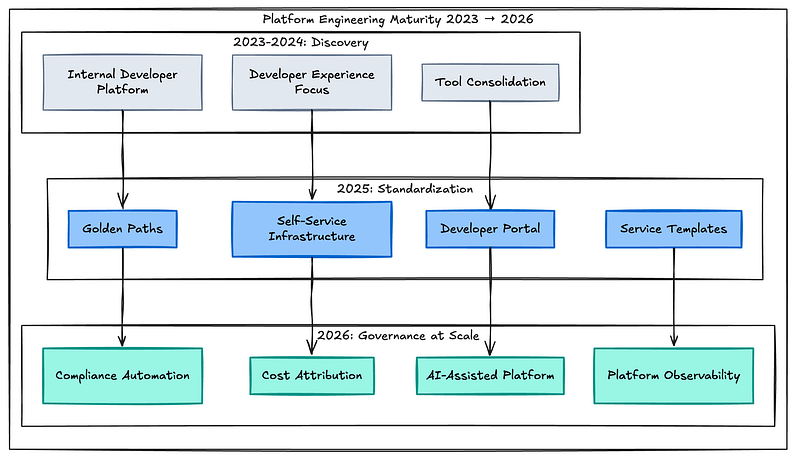
2. Platform Engineering Has Graduated
Platform engineering was the darling of 2023–2024 conferences. In November 2025, it’s table stakes.
QCon SF featured American Express sharing their 20+ years of infrastructure evolution. The session wasn’t “why platform engineering” but “how we matured our platform engineering practice.”
The shift is subtle but significant. We’ve moved from “build internal developer platforms” to “operate them at scale.”
3. Resilience Patterns With Production War Stories
This is where conference content has matured significantly.
I know the difference between theoretical resilience and battle-tested resilience. November 2025 conferences delivered the latter.
Netflix shared polyglot security patterns that handle real attacks at scale. LinkedIn walked through migrating a billion-user recommendation system without downtime. AWS re:Invent previewed multi-region patterns with specific failure scenarios.
The quality of resilience content has shifted from “here’s the pattern” to “here’s what broke, here’s what we learned.”
Have you experienced the gap between conference talks and production reality? Drop a comment with your war story.
4. Sustainability and Green Software Gaining Momentum
This surprised me.
Two years ago, sustainability talks were sparse. In November 2025, every major conference had multiple sessions on green software architecture.
QCon SF covered carbon-aware computing. SAG Berlin dedicated sessions to sustainable architecture principles. AWS highlighted energy-efficient region selection.
The business case is becoming clearer. FinOps and sustainability align when you realize that inefficient architecture costs money AND carbon.
After enabling a Health Data Platform architecture that supported a Series B funding round, I’ve learned investors increasingly ask about operational efficiency. Sustainability metrics are becoming part of that conversation.
5. Privacy Engineering as Shift-Left Architecture
Digital sovereignty and privacy engineering dominated AWS re:Invent previews. SAG Berlin featured European compliance perspectives.
This isn’t new for me. I’ve built platforms under GDPR, ISO 27001, and ISO 13485 across telecommunications, digital health, media, and conversational AI.
What’s new: privacy engineering is moving from legal afterthought to architectural first principle.
The pattern I’m seeing across conferences is treating data residency, consent management, and privacy by design as foundational architecture decisions, not compliance checkboxes.
What This Means for Your 2026 Architecture Roadmap
After absorbing 150+ speaker sessions across three conferences, here’s my distillation.
Start with AI architecture, not AI features. If you’re planning AI initiatives, begin with data architecture reviews. Where does your data live? What are your latency constraints? How do compliance boundaries affect model deployment?
Treat your platform as a product. If you have internal developer platforms, measure them. DORA metrics. Developer satisfaction. Time to first deployment. Your platform needs SLOs just like your customer-facing services.
Document your resilience assumptions. The gap I saw at conferences: teams have implicit resilience assumptions that have never been tested. Write them down. Test them. Learn from the Netflix and LinkedIn war stories.
Make sustainability visible. Track carbon impact alongside cost. These metrics will converge. Early adopters are already seeing this in their cloud bills.
Shift privacy left. European conferences (like SAG Berlin) are ahead here. Digital sovereignty isn’t going away. Architect for data residency from day one.
The Meta-Pattern: Architecture Conferences Are Growing Up
Here’s what nobody explicitly said but every speaker demonstrated.
Architecture discourse has matured.
We’ve moved past framework wars and technology hype. The conversations at QCon SF, SAG Berlin, and AWS re:Invent were about real systems, real failures, and real lessons.
I co-founded a technology company. I’ve been building edge-to-cloud systems since 2008, before the tools matured. The quality of architectural discourse in November 2025 exceeded anything I’ve seen in two decades.
The industry is finally talking about architecture the way it needs to be talked about: with humility, with data, and with war stories.
Experience matters more than conference slides. Go build something. Break it. Learn. Then share.
What’s the biggest architectural shift your organization is facing heading into 2026? Am I wrong about any of these trends? Tell me in the comments.
I am a human writer who gets motivated to write more with your support! You don’t need to pay. I just need your clap 👏 if you like my story and comment ✍️ if you want to say something. You can follow me on Medium, LinkedIn, Instagram, and X.